
Open one of your kitchen cabinet doors and look at the inside edge, right where your fingers land every day. That strip tells you more about the cabinet’s future than the front does. If the finish there has worn thin and the wood underneath looks dull and slightly fuzzy, the box itself is usually still fine. It’s the finish that quit.
That’s the whole case for refinishing. In Eagle and Star, most kitchens we look at have boxes that are sound, doors that hang straight, and drawers that still close the way they should. What’s tired is the surface. Tearing out the whole system to fix a surface is a lot of demolition for a problem that lives about a millimeter deep.
What refinishing actually involves
Refinishing isn’t painting cabinets the way you’d paint a bedroom wall. A wall gets rolled, it dries, and nobody touches it again. A cabinet door gets opened with wet hands, bumped with a hip, wiped down with a rag and closed a few thousand times a year. The finish has to survive all of that.
So the work is mostly preparation. Every surface gets degreased first, because kitchen grease is invisible and it will reject any coating you put over it. Then we sand to create tooth, so the primer has something to bite into, and fill the dings that have collected over the years. Only after that does anything get sprayed.
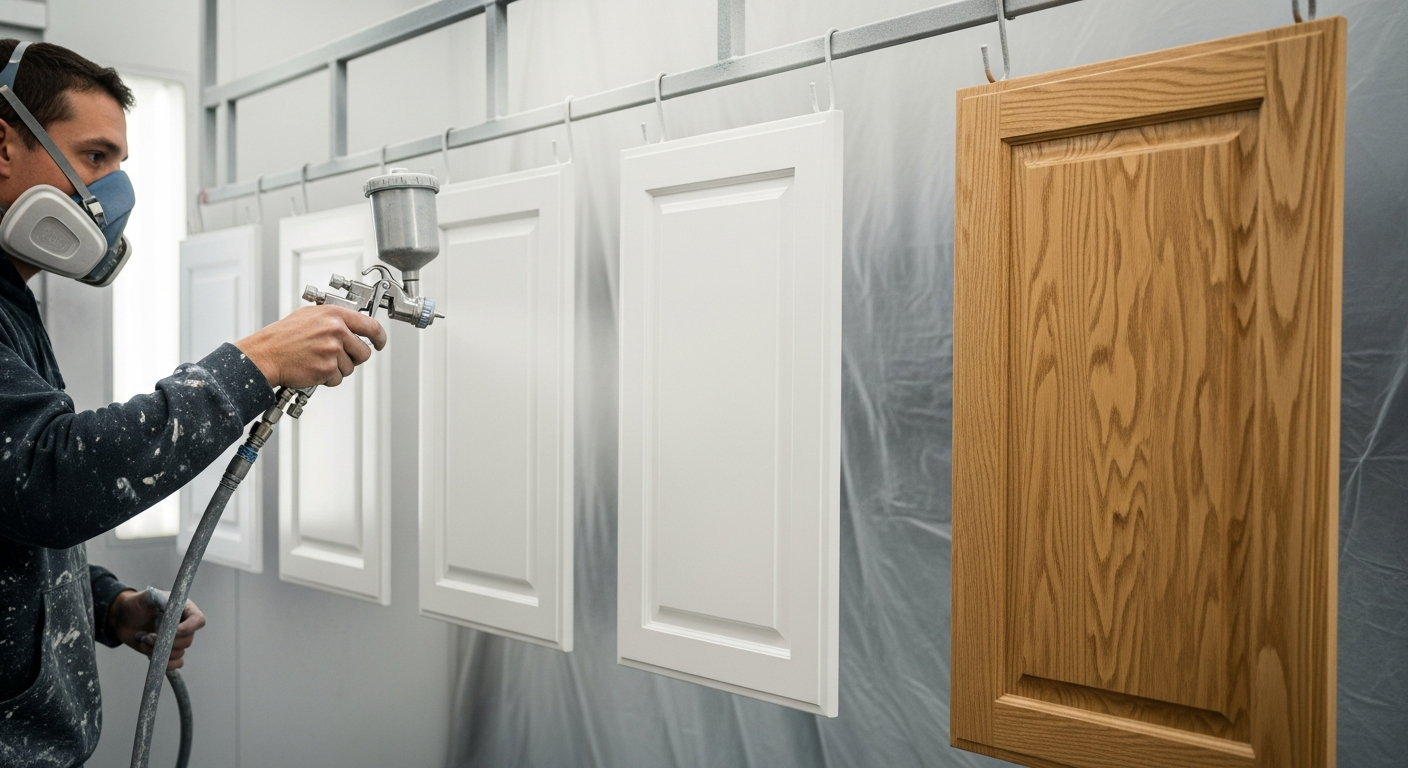
Sprayed, not brushed, and that matters more than most people expect. A brush leaves stipple and lap marks that catch the light across a flat door. On a run of 20 doors your eye reads the inconsistency even when it can’t name it. Sprayed enamel lays down flat, and the result looks like cabinetry instead of like a paint job.
Doors and drawer fronts come off and get sprayed in a controlled setup away from your living space, which keeps the overspray and the smell out of your house. The boxes get finished in place, masked off carefully, with the same primer and the same enamel so nothing reads as a different color when the doors go back on. You can see finished kitchens in our project portfolio.
Why Eagle and Star kitchens are good candidates
Housing in Eagle and Star runs heavily to homes built in the last 15 to 25 years, with a steady wave of newer construction on top of that. Two patterns show up over and over.
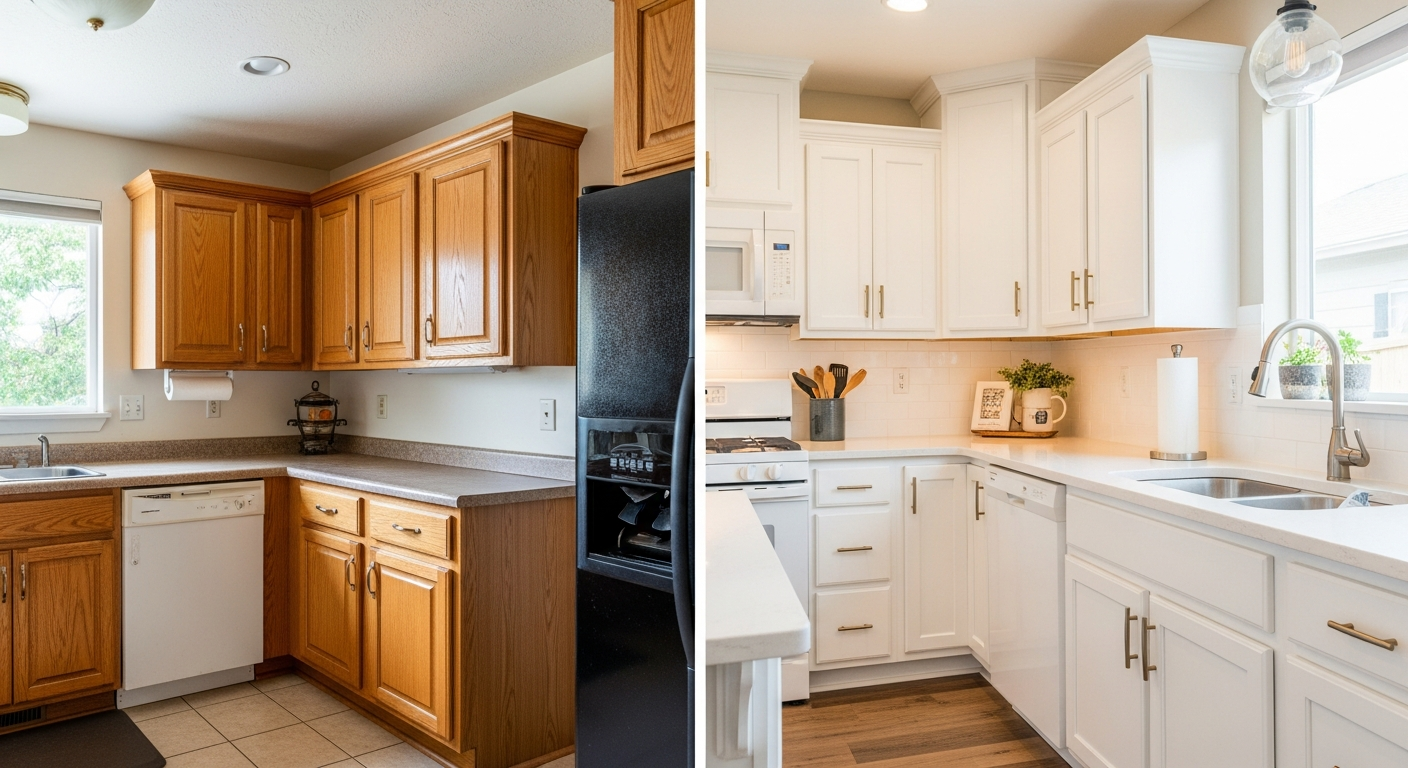
The first is early-2000s oak. Warm, orange-toned, heavily grained, and everywhere. The grain is the part people forget about. Oak has open pores, and if you spray straight over them the grain will ghost through and you’ll still read it under your new white. Getting a smooth modern look on oak means filling that pore structure first. It’s extra labor, and it’s the step a cheap quote quietly leaves out.
The second is builder-grade maple in newer homes. Smooth, tight-grained, easy to work with, and usually a flat beige nobody actually chose. Those kitchens take a color change beautifully. Honestly, that reveal is the part our crew enjoys most: you spend two days on prep nobody will ever see, the doors go back on, and it isn’t the same room anymore.
If your cabinets have been on your mind, call us at 208-972-0565 and we’ll come look at them in person. Opening a few doors and checking the boxes tells us in 10 minutes what no photo can.
How the process runs
Every kitchen is a little different, but the sequence doesn’t change. Here’s what happens once you say go:
- Walkthrough and evaluation. We check hinges, door alignment, drawer glides and the condition of the boxes, and confirm that refinishing is genuinely the right call for your kitchen.
- Removal and labeling. Doors, drawer fronts and hardware come off and get labeled so every piece returns to the exact opening it came from.
- Degrease, sand, repair. The step that decides whether the finish lasts. Grease comes off, surfaces get sanded to create tooth, dings and open grain get filled and smoothed.
- Bonding primer. A primer built for cabinetry, not a general-purpose wall primer, because adhesion on a horizontal surface people touch daily is a different problem.
- Sprayed enamel. Multiple thin coats rather than one heavy one, with cure time between them. Thin coats are what give you a hard, smooth surface instead of a soft one that dents.
- Reassembly and walkthrough. Everything goes back once the finish has cured properly, then we walk the kitchen with you and fix anything you point at.
Most kitchens run about a week, though yours gets a real schedule at the estimate rather than a guess from us here. Your sink, countertops and island keep working the whole time. What you lose is the use of cabinet doors while they’re out, and that’s the part worth planning around.
Choosing a color that holds up
White and off-white stay popular here for a reason. They read clean, they make a galley kitchen feel wider, and they don’t fight whatever your countertops are doing. Soft gray does similar work with a little more weight. Navy and charcoal look excellent on lower cabinets with something lighter above, though they show dust and fingerprints more honestly than a mid-tone will.
The real constraint isn’t the trend, it’s what’s already in the room. Your countertops, backsplash and flooring are staying, so the cabinet color has to work with all three. A cool white next to a warm travertine backsplash will look slightly off and most people can’t say why. We bring drawdowns, which are sample boards sprayed with the actual product, and leave them in your kitchen for a day so you see the color in your own light instead of under showroom lighting.
When refinishing is the wrong answer
Refinishing is right when the boxes are solid, the layout works and you’re happy with where things live. It’s the wrong call in a few specific situations, and we’d rather say so at the estimate than take the job.
If water has gotten into the particleboard under the sink and the material has swollen, paint won’t fix punky, failing substrate. If the doors are laminate or thermofoil and the surface is peeling away from the core, that’s a delamination problem, not a finish problem. And if what actually frustrates you is the layout, not the color, then refinishing leaves you with a better-looking version of the kitchen you already don’t like. Paint doesn’t move an island or add a drawer bank.
Everything else, which is most kitchens, is a good candidate. Cabinet work is also the service where the gap between careful and careless is widest, so it’s worth asking any contractor what their prep sequence is before you talk about anything else. If you want the full picture of how we handle this work across the valley, our cabinet painting page lays it out.
Frequently asked questions
How long does cabinet refinishing take?
Most kitchens run about a week from removal to reassembly, and the estimate is where you get a real schedule for yours. Kitchens with crown molding, glass inserts or a lot of decorative detail take longer, because every one of those adds prep and masking. Cure time between coats is the part that can’t be rushed, and it’s the reason a job pushed through in two days rarely holds up.
Can I use my kitchen while the work is happening?
Mostly, yes. Your sink, countertops, appliances and island keep working normally throughout. What you give up is access to the cabinet interiors while the doors and drawer fronts are out being sprayed, so it’s worth pulling everyday dishes, coffee and cooking basics onto the counter before we start. Most people settle into it after the first morning.
Will the grain still show through on oak cabinets?
Only if the grain isn’t filled first. Oak has open pores, and a finish sprayed straight over them will sink slightly into every pore and let the grain read through the new color. Filling and sanding that pore structure is what gives you a smooth, contemporary surface. It’s a real step with real labor behind it, and skipping it is the most common reason a refinished oak kitchen still looks like oak.
How do sprayed cabinets hold up to daily use?
A properly prepped, sprayed enamel finish is built for the abuse a kitchen hands out: wet hands, cleaning products, doors closing all day. Adhesion is what determines that, which is why degreasing and sanding matter more than the brand on the can. Our 5-year workmanship warranty covers peeling, blistering and flaking that come from application failure, so if the finish lets go because of how it was applied, we come back and fix it.
Do you refinish cabinets outside Eagle and Star?
Yes. We work throughout the Treasure Valley, including Meridian, Boise, Nampa, Caldwell, Middleton, Kuna and Garden City. Cabinet work travels well because the process is the same wherever the kitchen is, and scheduling across the valley is routine for us. If you’re not sure whether you’re in our area, call and ask.
Ready to refinish your cabinets in Eagle or Star?
Our work is backed by a 5-year workmanship warranty, which covers application failure like peeling, blistering and flaking, and we hold a 4.9-star rating on Google from the homeowners we’ve done this for. If you’d like someone to look at your kitchen and tell you straight whether refinishing makes sense, call 208-972-0565 and we’ll set up a time that works around your week.