
Fall light in Eagle and Star does something to a kitchen that nobody warns you about. The sun has swung south, the foothills have gone gold behind the ridgeline, and the light coming through your windows at 4 p.m. is a completely different color than the light you had in June. Suddenly the cabinets you’d made peace with all summer look heavy again.
That’s not your imagination, and it’s not a reason to panic-buy a paint chip. It’s the best possible moment to make a color decision, because the light you’re standing in now is close to the light your kitchen will live in from October through March, which is when you use that room most. Thanksgiving is close enough to count in weeks now, and between now and New Year’s this kitchen will host more people, more cooking and more photographs than the rest of the year combined.
We’re Funky Painting, a crew painting kitchens across the Treasure Valley, and this article is about the fun part of the decision: how the finished kitchen will actually look. If money is your first question, our Boise piece on refinishing versus replacing breaks down that math. If your first question is whether you have time, the scheduling breakdown for Meridian and Nampa will answer it.
Choose the Color in Your Own Kitchen, Not in the Store
Paint decks lie, and for a boring reason: store lighting has almost nothing in common with what’s over your sink. Eagle kitchens make it worse in an interesting way. A lot of newer homes off Floating Feather and around Two Rivers have big west-facing glass that pours warm afternoon light across the island, pushing a cool white toward cream by dinnertime. Kitchens with north-facing windows do the opposite and drift blue-gray all day. Out in Star, newer construction along Highway 44 sits on open ground where reflected light flattens undertones and makes soft grays read chalky.
So test at home, and test bigger than a chip. Get a sample door or an 8-by-11 drawdown of the actual product, then set it flat against the counter and the floor rather than taping it to the old cabinet color. Your counter and flooring aren’t changing, and they’re the constraints the color has to live with. Look at it at 8 a.m., again mid-afternoon, and again at night under your own bulbs. With 2,700K LEDs, warm whites glow and cool whites go gray. Swap in 4,000K and the whole conversation flips.
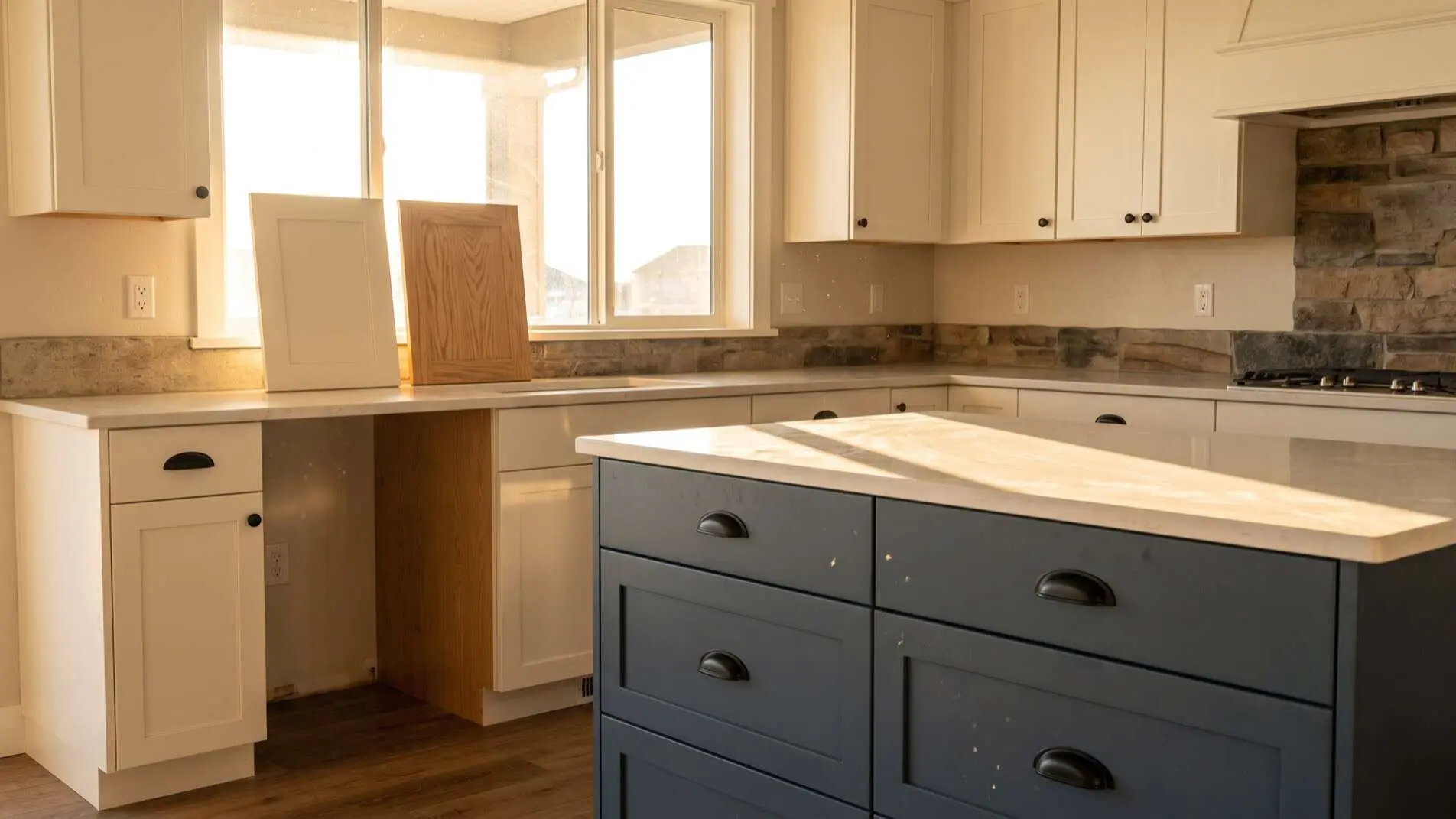
Undertone is the other thing worth naming out loud. Most of the whites homeowners fall for have a warm base, which is why they sit well with the granite and travertine common in homes built here in the 2000s. Greige has been climbing fast, sage green right behind it, and a darker island under a warm white perimeter is still the two-tone we quote most.
Grain and Sheen, the Two Choices That Change the Whole Look
Oak is the great fork in the road. Red oak has deep open grain, and paint doesn’t hide it. Spray a straight enamel over an oak door and you get a smooth surface with visible texture running through it, which reads warm, slightly farmhouse, and clearly intentional. Fill it, using grain filler and a high-build primer with real sanding between coats, and you get flat and modern, closer to a factory MDF door. Neither is the right answer, but it is a permanent one, so we bring both sample doors and let you touch them. Maple and MDF doors, common in Star’s newer builds, spray glass smooth without any of that work. Cost enters here only lightly: grain filling moves you up inside the range your kitchen already sits in rather than past it, and we price that choice in front of you at the estimate.
Sheen is a durability question before it’s a looks question. Matte and flat hide surface waves beautifully and mark up faster under a wet dishrag. Semi-gloss wipes cleanest and reflects most, which also means it announces every ripple in an old door and every fingerprint near the coffee maker. Satin sits between them, which is why we spec it on most kitchens. If you want more shine, put it on an island where the doors are newer and flatter.
Here’s the moment our crew waits for on a filled-grain job. The first door comes off the rack, catches the light, and there’s nothing there. No grain, no brush marks, no orange. Old oak looking like it was made last week never stops being satisfying.
Ready to see samples in your own kitchen light instead of on a screen? Call 208-972-0565 and we’ll bring drawdowns and sample doors out to you.
Hardware Is the Cheapest Upgrade in the Room
Changing pulls alongside the finish costs very little and changes more than people expect, because hardware is the only part of a cabinet you physically touch. A few things worth knowing before you order.
Older Eagle and Star kitchens usually have knobs on the doors and 3-inch center-to-center pulls on the drawers. Current taste runs longer, often 5-inch or 6-inch on wide drawers, with cup pulls on the base run. If your new spacing doesn’t match the old holes, we fill and refinish those spots during prep so nothing telegraphs through, which is the one detail to raise at the estimate rather than on install day.
On finish, matte black over warm white still looks current and forgives fingerprints. Unlacquered brass will patina over the years, which some people love and some people are surprised by. Satin nickel is the easiest match if your faucet and appliances are stainless. Mixing two metals works fine as long as one of them repeats somewhere, usually at the faucet or the pendants.
Hinges deserve a thought too. Painting over exposed hinges on old oak looks exactly like what it is. Swapping them for new exposed hinges in your chosen finish is simple. Converting to concealed euro hinges means boring new cups into every door, which is a bigger conversation.
Five Days, Start to Finish
Once the choices are made, here’s how the week runs.
- Day one. Hinges and slides checked, repairs flagged, then doors, drawer fronts and hardware come off and get labeled piece by piece.
- Day two. Degreasing, the least glamorous and most important day, followed by scuff-sanding, filling, and grain filler if you chose it.
- Day three. Bonding primer everywhere, with boxes and frames masked and coated in place while your sink and appliances stay in service.
- Day four. Cabinet-grade enamel in thin coats. Fronts are sprayed horizontally in a controlled setup kept apart from your living space, so the finish lays down flat and overspray never reaches your house.
- Day five. Reassembly, new hardware if you picked it, then every door adjusted until the gaps run even and everything closes right.
Five days is the norm here. Big custom kitchens with islands, glass uppers and a pantry wall can add a day or two.
One calendar note. October dates go quickly once the exterior season ends, and every year a few homeowners call the week before Thanksgiving hoping for a miracle. Booking now means you choose your week.
FAQ
What cabinet color are Eagle and Star homeowners actually picking right now?
Warm whites and soft creams still lead by a wide margin, because they sit well with the granite and wood tones common in homes built here in the 2000s. Greige is the fastest riser, with sage green close behind. For two-tone kitchens, a deep blue-gray island under a warm white perimeter is the combination we quote most. We bring samples so you’re choosing in your own light rather than from a photo.
Should I fill the oak grain or leave it showing?
Filled grain gives you a flat, modern, almost factory-made surface. Left open, that texture reads under the color and keeps a softer, more traditional feel. Filling adds sanding time and usually a day, so it does affect price. Look at both sample doors in your kitchen first, because the choice is permanent short of stripping everything back.
What sheen holds up best on cabinet doors?
Satin is the workhorse and what we recommend for most kitchens. It cleans easily, resists marking around handles, and reflects just enough light without highlighting every imperfection in a 20-year-old door. Semi-gloss wipes cleaner still but shows waviness and prints, so it suits newer, flatter doors. Flat and matte photograph beautifully and are the least forgiving to scrub.
Can you paint the island a different color from the rest?
Yes, and it’s one of the most effective moves available in a long kitchen. A darker island grounds the room and gives the eye somewhere to land, which matters in the open floor plans common around Eagle. Pick the perimeter color first, then choose the island against it in your actual light. Two-tone work adds a little labor and rarely changes the project length.
Do I have to replace my hardware when the color changes?
Not at all, and plenty of kitchens keep their existing pulls, especially solid brass or a finish you already like. That said, new hardware over fresh enamel is the highest-impact dollar in the project, and reinstall day is the only time it costs nothing extra in labor. If you’re switching hole spacing, raise it at the estimate so the filling happens during prep.
Bring Your Kitchen Into the Light It Deserves
If your Eagle or Star kitchen is about to work overtime for three months straight, give it the color it should have had all along. Call Funky Painting at 208-972-0565 and we’ll bring real samples, talk through grain, sheen and pulls, and map out the week. Our cabinet service page covers the technical side, and you can look through what we’ve painted in Eagle and Star.
We’re a PCA Accredited Contractor, which means our process gets held to an industry standard rather than a house standard, and we’ve now completed more than 1,500 projects across this valley.